How can I protect a parked motorcycle from theft?
A quick shop visit still leaves a motorcycle exposed, and a garage does not replace locking the bike itself. Combine a lock, chain and cover to restrict movement, secure the bike to something fixed and conceal its model. At home, check the garage, shed or motorcycle locker as well as the bike's locks and anchor. Take your helmet and other accessories with you where possible: the bike can remain locked while loose kit is stolen. These precautions reduce opportunities; they cannot guarantee safety, and theft is the offender's responsibility.
ishowcrime desk
Sources checked 1 November 2026
Here’s what you can do.
Lock it and take the keys
Use the steering lock and remove the ignition key, even for a short stop. Add a suitable disc, grip or wheel lock. Steering locks alone can be defeated, so an additional physical lock helps resist the bike simply being moved away. Before buying a lock, ask your insurer which specification and grade your policy requires. Check the exact model in Sold Secure's official approved-product search, including its Powered Cycle rating for motorcycle use. A rating for a pedal cycle is not the same specification. Sold Secure updates its listings, so check there rather than relying only on a seller's claim. If you cannot find the model, ask Sold Secure to confirm it.
Anchor the bike and take your kit
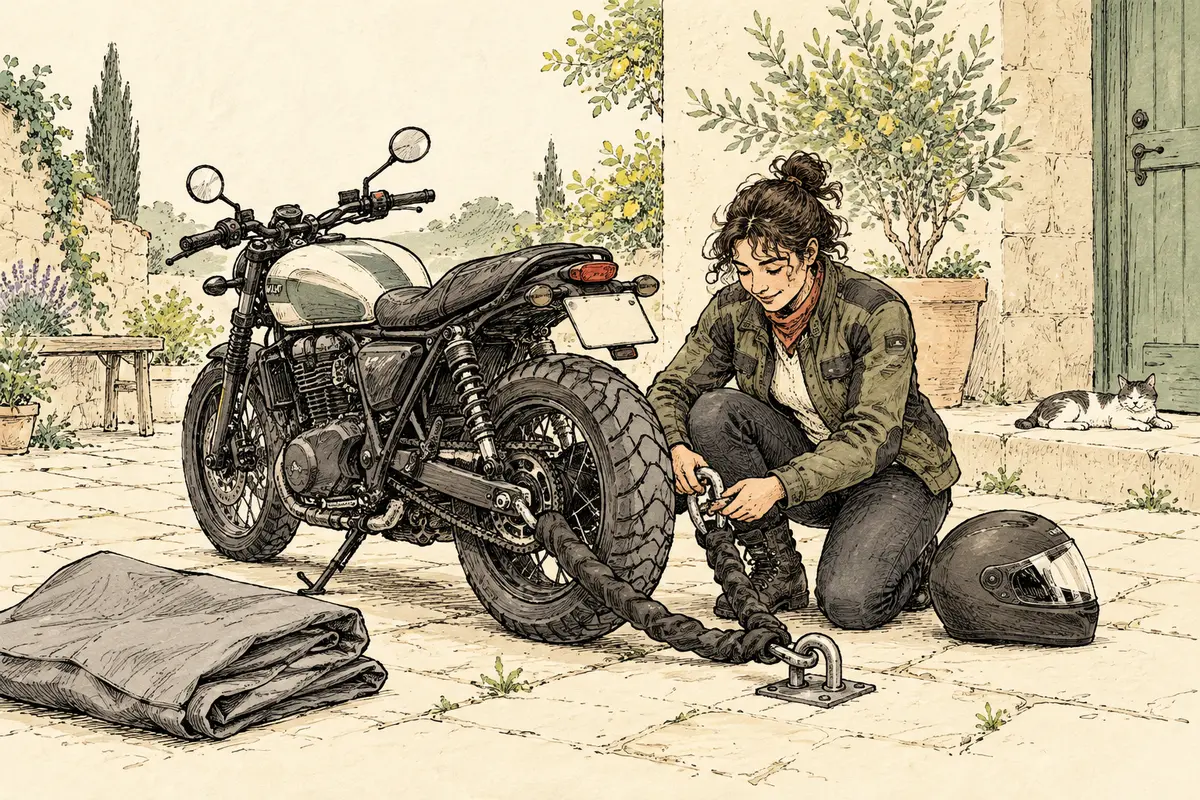
Secure the rear wheel to an immovable anchor with a suitable chain, kept taut and off the ground where possible. If there is no anchor, police advise passing the chain through the frame and rear wheel. This is a fallback, not the same as anchoring it. West Yorkshire Police advise taking your helmet and other accessories with you where possible, rather than leaving them on the bike or in panniers. Locking the motorcycle does not protect every item left with it. If your helmet is stolen, arrange another way home or a suitable replacement before riding. Riders and pillion passengers must wear a compliant, securely fastened helmet on every road journey, with an exemption for Sikhs wearing turbans. A short ride home is not an exception. Report a theft discovered later on 101; call 999 for a crime in progress or immediate danger.
Choose storage and keep identifying details
At home, use a secure garage, shed or motorcycle locker where available, and keep using the bike's locks and anchor. If you must park outside, choose a well-lit place near home that is visible from nearby homes or buildings, then cover the motorcycle. A cover conceals the model and adds an obstacle; it is not a replacement for locking. Record the registration, make, model and colour. Consider marking parts, which can help police identify recovered property. If you see a theft happening, stay clear and call 999. Report a theft discovered later through non-emergency channels. If you receive a tracker alert while away, contact the provider through its official theft-reporting route and tell police if you suspect theft. The tracker FAQ explains BikeTrac's process; do not assume the app has made your crime report.
Your quick checklist.
Tick what you’ve done. This stays on this page.
0 of 3 markedDownload a short text copy to read without internet. It cannot call or alert anyone.
A few things explained.
Does keeping a motorcycle in a garage make extra security unnecessary?
No. Police recommend securing the storage space and the motorcycle. Consider stronger garage-door locks or a garage door defender, with a ground anchor for the bike. A shed or garage alarm and suitable lighting add further layers. If you have no garage, a motorcycle locker may be an option; otherwise use well-lit, overlooked parking. The related shed-and-garage guide explains checks for the building's doors, hinges and windows.
Can a tracker replace locks, and what should I do after an alert?
No. A cover conceals the model, and a professionally fitted tracker may help police trace a stolen motorcycle. Neither replaces locks or guarantees recovery. Do not follow a map to recover it yourself. Follow your provider's theft procedure. For BikeTrac, its terms require you to tell police the vehicle has a tracker, obtain a crime reference and pass it to its Secure Operating Centre. Its contact page says to log into your account and call the centre number on your dashboard. A tracker alert does not remove your responsibility to report suspected theft. BikeTrac says it blocks customer map access once theft is confirmed, for personal safety, and restores access after resolution. That restriction is not by itself evidence that the tracker has stopped working. Other providers' procedures differ; check your own service's official guidance.
What should I do if my motorcycle is stolen or later recovered?
Tell police and your insurer straight away. For a theft discovered afterwards, call 101 with the registration, make, model and colour, and keep the crime reference for your insurer. Police notify DVLA about the theft and recovery. If the insurer pays out, you must separately tell DVLA the vehicle has been sold to the insurer. Follow the linked GOV.UK instructions, including its advice if you want to retain a personalised registration. If the Metropolitan Police recover it, follow the collection notice promptly and speak to your insurer before arranging collection if you have made a claim. Removal and storage charges can apply; whether your insurer pays depends on your cover and circumstances. The Met recommends having a recovered stolen vehicle transported to a garage for inspection before driving it, because it may have been damaged. Finding the bike does not establish that it is safe to ride.