Crime Fiction — original imagined story. The Bellweather is an invented British seaside hotel. Its characters, events and local history are fictional.
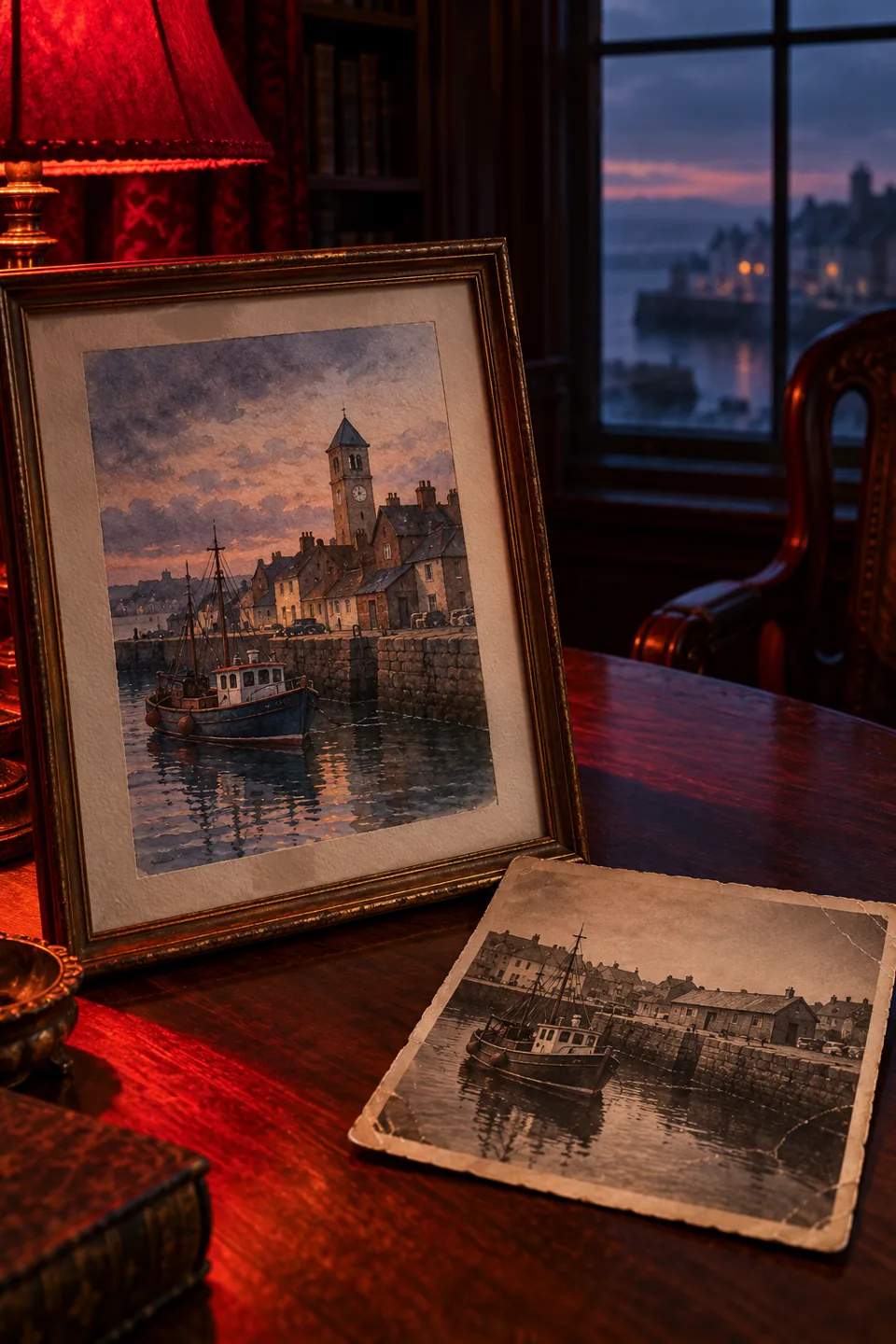
The clock tower in the painting had four faces. In the photograph beneath it, there was only sky.
Mara noticed the difference while clearing a space for the catalogue. A dealer had hired the Bellweather’s reading room for a private viewing, and the table was already crowded: a framed watercolour, a folder of letters, cups nobody had finished. Through the window, the real tower stood above the harbour. Its clock was seven minutes slow.
“Don’t put that underneath,” the dealer said. “Old photographs scratch.” He took the picture from Mara and slid it into his folder. His name was Noel Dacre. He wore a soft brown suit and had spent most of the morning describing things as exceptionally rare.
The watercolour showed a fishing boat beside the harbour steps. Above the roofs, the tower caught a wash of pale evening light. At the bottom, in small brown letters, was a signature: M. Wren, 1953. Dacre’s catalogue called it a rediscovered work by Marjorie Wren, a local painter who had died in 1956.
Ruth Calder, the prospective buyer, had come with a cheque book. She wanted the picture for the town’s reading society, which was moving into new rooms. Four thousand pounds was almost the whole of its decorating fund. “If it’s right,” she told Inez. “We’ve enough blank walls without buying a mistake.”
Inez had supplied the room and the coffee, not an endorsement. She said so. Dacre smiled and opened his folder at a typed letter, apparently written by Wren’s nephew in 1971. It described finding the picture in his aunt’s studio. There was also the old photograph of the harbour, printed with a broad white border.
Mara went to find Dev. He was in the breakfast room, examining a clock movement through his round glasses. When she described the painting, he put his screwdriver down. “The harbour tower? I helped clean its mechanism last spring. There’s a plaque inside. It opened in 1962.”
She brought him to the reading-room door. They could see the painted tower without going in. There was its narrow balcony, the pointed roof and the shallow arch beneath the clock. Dev looked from the picture to the actual building beyond the window. “Same tower,” he said. “Nine years early.”
A painter might have imagined a building later constructed, or added something to an older picture. Mara asked Dacre whether the work had been altered. He said it was untouched. When Dev mentioned 1962, the dealer shut the catalogue. “That was the restoration. The tower itself is older.”
“I can check,” Inez said. She rang the harbour office on the number in the hotel’s directory. Ruth closed her cheque book while they waited. Dacre suggested that a clerk would know little about art. “We’re asking about a building,” Ruth replied.
The harbour secretary emailed a scan of the opening programme. Dev and Inez read it together: a new tower, completed in 1962, on the site of a demolished store. The cover showed workmen laying its foundations. Inez printed the relevant pages and brought them to the table.
Dacre moved the frame so that the window reflected across its glass. “Then the date has been misread. An eight can look like a five.” Mara looked at the catalogue he had written. It said 1953 twice. Changing that to 1983 would put the painting twenty-seven years after Wren’s death.
Ruth pushed her cheque book into her bag. The purchase was off. Dacre began gathering his papers, but Mara still wanted to see the photograph he had moved. “May we compare those rooflines? You showed it as part of the history.” He placed it on the table with two fingers over the bottom edge.
The photograph had no tower. In its place stood the low harbour store. Otherwise, it was remarkably close to the watercolour: the same boat, a basket leaning against its wheelhouse, two gulls above the mast. The boat’s name was partly hidden behind a rope in both. Someone had copied this photograph and added a building.
“Or Wren painted from a photograph,” Dacre said. Dev agreed that she could have done. That did not explain the tower. It also did not establish who had painted the picture. Ruth asked to examine the back of the frame. Dacre said the brown paper was a protective seal and must not be disturbed.
Mara recognised the frame’s construction: swivelling metal tabs and a backing board, like the frames used at the hotel’s Saturday art classes. The paper over the back had been stuck on recently; a loose corner was still curled away from the wood.
With Dacre’s reluctant permission, Inez lifted that corner. Beneath it was a small white label, visible without removing the board. Mara knew the handwriting. June Fenn, who taught the classes, wrote her sevens with a bar through them. The label read: Harbour study, after photograph. J. Fenn. £70.
No one spoke for a moment. The label might have belonged to a reused frame. Ruth said that before Dacre could. “But we’ve now got two things to check. A building that hadn’t been built, and a study by someone else.”
June was working in the hotel’s conservatory that morning, packing brushes after a private lesson. Inez asked her to come through. She recognised the watercolour immediately. She had copied the old photograph for an exercise in changing a scene, adding the familiar tower to an earlier harbour view. It was her own modern study, not a Wren reproduction.
“You bought it from me,” she told Dacre. “You said your sister liked boats.” She showed Ruth the photograph on her phone of the finished picture, taken before it was framed. There was no Wren signature. Her sale receipt named Dacre and described the work as a contemporary watercolour by June Fenn. The purchase had been made six weeks earlier.
Dacre said he had been mistaken about the artist, then stopped. Mara looked at the phone photograph again. The forged signature had been added where June had left the foreground almost blank. The old harbour photograph and the nephew’s letter had made a convincing little history around a picture whose tower contradicted it.
Inez asked Dacre to remain while she called the police. She did not lock the door or take his belongings. Before the officer arrived, he admitted in front of Ruth and June that he had added the signature and typed the letter himself. He had copied the nephew’s name from a book about Wren. “I thought nobody would bother about the buildings,” he said.
The officer took accounts from everyone involved and photographed the painting, label, catalogue and receipt. Ruth had paid nothing. June supplied her original phone image and retained a copy of her receipt. Whether Dacre had offered other altered pictures was a question for the investigation; the people in the reading room could answer only for this one.
Weeks later, when the painting was released and June had bought it back from Dacre, she removed the false signature and signed her own name on the front. Ruth bought it for the reading society at June’s usual price. Beneath it she hung a small card explaining the exercise: an old harbour, with a later tower added. Nobody had to pretend it was rare.
On the morning the society opened its rooms, Dev finally adjusted the tower clock. Mara watched from the pavement while Inez checked her watch. When the hands reached eleven, the bell began. “It’s caught up,” Inez said. Mara looked through the society’s open door at June’s picture. For once, both towers were exactly where they belonged.