A customer hands me a suspicious banknote. What should I do?
A customer hands you a Bank of England note that does not look quite right. A quick glance or a detector pen cannot settle it, and an unusual-looking note does not prove the customer knew anything was wrong. Check the note's security features without accusing anyone. Your safety comes first if the exchange feels threatening. If the note has already gone into the till, do not pass it on: your bank or police can arrange for it to be examined.
ishowcrime desk
Sources checked 15 November 2026
Here’s what you can do.
Check the note, calmly
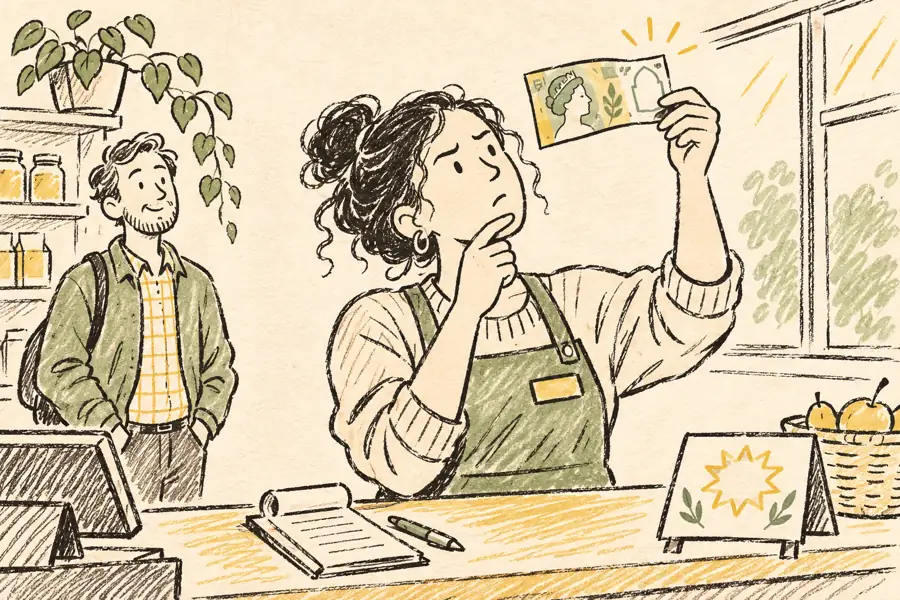
If you can do so safely, compare the note with the Bank of England's current guides. Look for the see-through window with a clear portrait, tilt the note to check the changing foil, and feel for raised print. Both King Charles III and Queen Elizabeth II polymer notes remain in circulation. Check more than one feature: the Bank says detector pens do not spot counterfeits printed on polymer. A concern is a reason to follow your shop's policy, not proof that this customer deliberately offered a fake.
Put staff safety before the payment
Follow your employer's policy. The Bank of England's retailer guide says that if you feel at risk while the customer is present, refuse the note, ask for another form of payment and contact police when safe. If you feel safe, its best-practice route is to keep the suspect note, give the customer a receipt, ask for another way to pay and explain that a genuine note will be reimbursed. Ask a manager for support rather than turning the check into an argument. Call 999 if someone is in immediate danger or a crime is in progress.
Arrange examination; never recirculate it
If you discover the suspect note after the customer has left, the Bank says to take it to your bank as a suspect counterfeit or contact police. The same routes apply to a note kept safely at the till. Give the bank or police the facts you know about when it was received, without guessing who made it or what the customer knew. The Bank says counterfeit notes are worthless and cannot be reimbursed; if a suspect note is found genuine after examination, you will be reimbursed. Do not use it as change or spend it elsewhere.
Your quick checklist.
Tick what you’ve done. This stays on this page.
0 of 3 markedDownload a short text copy to read without internet. It cannot call or alert anyone.
A few things explained.
Do Bank of England notes with the Queen's portrait still count?
Yes. The Bank of England says polymer notes bearing Queen Elizabeth II and King Charles III circulate together. Check the security features of the denomination rather than treating the older portrait alone as a warning sign.
Can I rely on a counterfeit-detection pen?
No. The Bank of England says detector pens do not spot counterfeits printed on polymer. Use its look, tilt and feel guidance and check more than one feature. If the result remains uncertain, follow the shop's suspect-note procedure.
What if we spot the note after the customer leaves?
Do not put it back into circulation or accuse a customer without evidence. The Bank of England tells retailers to take a note found after the customer leaves to their bank as a suspect counterfeit or contact police. A bank or police can arrange examination; a genuine note is reimbursed, but a counterfeit one is not.